Paycom vs. Rippling: Comparing Payroll and HR Systems
This page compares Paycom and Rippling for midmarket teams choosing between a focused HR and payroll system of record and Rippling’s converged IT, Spend and HR platform. The practical question for HR-pure buyers is whether they need HR and payroll depth backed by a dedicated U.S. service model, or a broader workforce platform that also spans device management and corporate spend.
Paycom vs. Rippling at a glance
Key differences between Paycom and Rippling
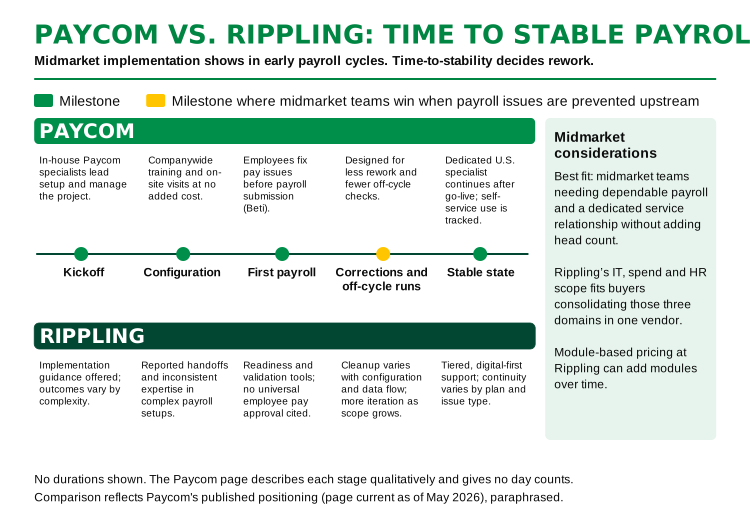
Paycom and Rippling take different approaches to how payroll and HR operations are delivered and supported. For midmarket teams, the practical question is how quickly you can reach a stable baseline—and how much ongoing work it takes to keep payroll and HR running smoothly.
Paycom centralizes payroll, HR, talent management, talent acquisition, and time and labor on a single database, with in-house implementation and a dedicated U.S. specialist for ongoing service. Rippling positions a converged platform that combines HR and payroll with IT Cloud (device management, SSO, app provisioning) and Finance Cloud (corporate cards, spend, bill pay), priced by module. For HR-pure buyers, those differences can show up as payroll accuracy, day-to-day admin effort, support continuity, and how much of the platform scope sits outside core HR and payroll.
Setup, support and time-to-value
Rippling vs. Paycom: How fast can you get live, and who helps?
 |  | Why this matters | |
|---|---|---|---|
| Implementation approach | In-house implementation delivered by Paycom specialists, with personalized project management, companywide training and on-site visits at no additional cost to reduce rework in early payroll cycles. | Implementation outcomes vary by complexity, with reported handoffs and inconsistent expertise in more complex payroll setups. | A consistent implementation team can reduce delays and rework, especially in complex payroll environments. |
| Support model | Dedicated U.S.-based specialist who knows the client’s configuration and history, providing continuity from go-live through ongoing optimization. | Support is typically tiered and digital-first (chat and email channels with response targets), with continuity that can vary by plan and issue type. | Continuity can speed resolution and reduce repeated explaining when issues affect payroll or employee experience. |
| Time to stability | Guided setup and training designed to reach a stable baseline faster with less early-cycle rework. | Stability may take more iteration as scope and configuration complexity increase. | Reaching stability sooner helps avoid early-cycle firefighting and builds confidence in payroll. |
| Proof after go-live | Direct Data Exchange® tracks employee self-service usage in real time, surfacing adoption gaps and quantifying time saved as it relates to automation. | No equivalent cited here for in-platform usage and ROI measurement after go-live. | Usage visibility helps teams drive adoption and quantify time saved. |
| | Why this matters |
|---|---|---|
| Implementation approach | ||
| In-house implementation delivered by Paycom specialists, with personalized project management, companywide training and on-site visits at no additional cost to reduce rework in early payroll cycles. | Implementation outcomes vary by complexity, with reported handoffs and inconsistent expertise in more complex payroll setups. | A consistent implementation team can reduce delays and rework, especially in complex payroll environments. |
| Support model | ||
| Dedicated U.S.-based specialist who knows the client’s configuration and history, providing continuity from go-live through ongoing optimization. | Support is typically tiered and digital-first (chat and email channels with response targets), with continuity that can vary by plan and issue type. | Continuity can speed resolution and reduce repeated explaining when issues affect payroll or employee experience. |
| Time to stability | ||
| Guided setup and training designed to reach a stable baseline faster with less early-cycle rework. | Stability may take more iteration as scope and configuration complexity increase. | Reaching stability sooner helps avoid early-cycle firefighting and builds confidence in payroll. |
| Proof after go-live | ||
| Direct Data Exchange® tracks employee self-service usage in real time, surfacing adoption gaps and quantifying time saved as it relates to automation. | No equivalent cited here for in-platform usage and ROI measurement after go-live. | Usage visibility helps teams drive adoption and quantify time saved. |
Findings draw on publicly available product information, vendor security and trust disclosures, and third-party industry references. Last updated May 11, 2026. ISO/IEC 42001:2023, Information technology — Artificial intelligence — Management system (iso.org); Uptime Institute — Tier Certification Awards List (uptimeinstitute.com/uptime-institute-awards/list); Professional Background Screening Association (PBSA) — accreditation directory and standards (thepbsa.org); Rippling — product pages for HR Cloud, IT Cloud, Finance Cloud, Global Payroll and Trust/Security (rippling.com); Rippling People Inc. — S-1/A registration statement filed with the U.S. Securities and Exchange Commission (sec.gov), covering the converged HR, IT and Finance platform model and module-based pricing.
Why “time-to-stability” matters for midmarket teams
In midmarket environments, implementation shows up most clearly in the first few payroll cycles. When ownership is fragmented or handoffs are unclear, teams often spend additional time validating data, fixing payroll errors and issuing off-cycle corrections.
A consistent implementation team paired with continuity in support can help teams reach a stable baseline faster, allowing HR and payroll to focus on people work instead of troubleshooting. Post-go-live usage visibility also helps leaders prioritize the next workflow to automate.
Core platform, payroll and data integrity
Will payroll be right the first time?
| | Why this matters | |
|---|---|---|---|
| Platform architecture | Unified HCM record on a single database built in-house, so changes flow across payroll, HR, time, talent and onboarding without integrations between modules. | Converged employee record spans HR, IT (devices, SSO, app access) and finance (spend, corporate cards, bill pay). HR-pure buyers may pay for and govern scope outside core HR and payroll. | A single system of record can reduce discrepancies and reconciliation work. |
| Payroll accuracy approach | Employees review, identify and resolve pay-impacting issues before payroll submission, shifting error correction upstream of payday (Beti®). | Payroll readiness and validation tools exist, but no equivalent universal employee paycheck-approval step before payday is cited in product materials. | Preventing issues before payday reduces off-cycle checks and corrections. |
| AI reliability | Record-grounded AI returns answers pulled directly from the employee record inside one governed software, with permission-aware responses for HR and payroll questions (IWant™). | AI is positioned as an action layer across HR, IT and finance with workflow automation and policy bots; answer accuracy depends on which connected systems are in scope and how cleanly data flows between them. | Reliable AI depends on a closed, governed system of record. |
| Automation philosophy | Prevention-first automation pushes clean data into payroll. | Workflow routing depends on configuration and clean data flow. | Prevention reduces downstream cleanup. |
| Policy-driven time off | Employer-defined rules auto-approve or deny time-off requests, with outcomes flowing directly into payroll without manual handoffs (GONE®). | Workflows may automate notifications depending on setup. | Policy-driven decisions reduce manager burden and pay exceptions. |
| Manager mobile breadth | Managers handle approvals plus recruiting, hiring, scheduling, learning, employee inquiries and expiring certifications in one mobile app (Manager on-the-Go®). | Mobile app supports manager review and approvals for timecards, time-off and expenses. | Broader in-app workflows keep people processes moving when managers are in the field. |
| Background checks | Native background checks embedded in hiring workflows (Enhanced Background Checks®). Paycom is accredited by the Professional Background Screening Association (PBSA). | Background checks are typically delivered through connected screening providers. | Native steps can reduce time-to-start and limit data handoffs across vendors during hiring. |
| Expense and mileage | Approved expenses flow directly into payroll, and mileage reimbursements are calculated automatically inside the same software (Mileage Tracker). | Spend Management is a separately priced module within Finance Cloud (corporate cards, expenses, bill pay). | Native expense-to-payroll handling reduces reentry and reimbursement delays for HR-pure buyers. |
| | Why this matters |
|---|---|---|
| Platform architecture | ||
| Unified HCM record on a single database built in-house, so changes flow across payroll, HR, time, talent and onboarding without integrations between modules. | Converged employee record spans HR, IT (devices, SSO, app access) and finance (spend, corporate cards, bill pay). HR-pure buyers may pay for and govern scope outside core HR and payroll. | A single system of record can reduce discrepancies and reconciliation work. |
| Payroll accuracy approach | ||
| Employees review, identify and resolve pay-impacting issues before payroll submission, shifting error correction upstream of payday (Beti®). | Payroll readiness and validation tools exist, but no equivalent universal employee paycheck-approval step before payday is cited in product materials. | Preventing issues before payday reduces off-cycle checks and corrections. |
| AI reliability | ||
| Record-grounded AI returns answers pulled directly from the employee record inside one governed software, with permission-aware responses for HR and payroll questions (IWant™). | AI is positioned as an action layer across HR, IT and finance with workflow automation and policy bots; answer accuracy depends on which connected systems are in scope and how cleanly data flows between them. | Reliable AI depends on a closed, governed system of record. |
| Automation philosophy | ||
| Prevention-first automation pushes clean data into payroll. | Workflow routing depends on configuration and clean data flow. | Prevention reduces downstream cleanup. |
| Policy-driven time off | ||
| Employer-defined rules auto-approve or deny time-off requests, with outcomes flowing directly into payroll without manual handoffs (GONE®). | Workflows may automate notifications depending on setup. | Policy-driven decisions reduce manager burden and pay exceptions. |
| Manager mobile breadth | ||
| Managers handle approvals plus recruiting, hiring, scheduling, learning, employee inquiries and expiring certifications in one mobile app (Manager on-the-Go®). | Mobile app supports manager review and approvals for timecards, time-off and expenses. | Broader in-app workflows keep people processes moving when managers are in the field. |
| Background checks | ||
| Native background checks embedded in hiring workflows (Enhanced Background Checks®). Paycom is accredited by the Professional Background Screening Association (PBSA). | Background checks are typically delivered through connected screening providers. | Native steps can reduce time-to-start and limit data handoffs across vendors during hiring. |
| Expense and mileage | ||
| Approved expenses flow directly into payroll, and mileage reimbursements are calculated automatically inside the same software (Mileage Tracker). | Spend Management is a separately priced module within Finance Cloud (corporate cards, expenses, bill pay). | Native expense-to-payroll handling reduces reentry and reimbursement delays for HR-pure buyers. |
Findings draw on publicly available product information, vendor security and trust disclosures, and third-party industry references. Last updated May 11, 2026. ISO/IEC 42001:2023, Information technology — Artificial intelligence — Management system (iso.org); Uptime Institute — Tier Certification Awards List (uptimeinstitute.com/uptime-institute-awards/list); Professional Background Screening Association (PBSA) — accreditation directory and standards (thepbsa.org); Rippling — product pages for HR Cloud, IT Cloud, Finance Cloud, Global Payroll and Trust/Security (rippling.com); Rippling People Inc. — S-1/A registration statement filed with the U.S. Securities and Exchange Commission (sec.gov), covering the converged HR, IT and Finance platform model and module-based pricing.
Midmarket teams win when payroll issues are prevented upstream
Automation does not reduce work if teams still fix errors after payroll runs. Paycom emphasizes employee-driven workflows and policy-based automation designed to surface issues early — before they result in off-cycle checks, rework or employee frustration.
Rippling emphasizes workflow orchestration across HR, IT and finance, which can help route tasks. For midmarket buyers, results often depend on configuration depth and how consistently pay-impacting changes flow into payroll without additional cleanup.
Scaling without adding admin overhead
How much coordination is required to grow with each platform?
| | Why this matters | |
|---|---|---|---|
| Scalability model | Core HR and payroll in one system of record. | Broad platform requiring more integrations as scope grows. | Fewer dependencies mean fewer breakpoints as complexity increases. |
| Admin workload to scale | Prevention-first workflows reduce corrections as change increases. | Cleanup varies with configuration and data flow. | Reducing corrections protects lean team capacity. |
| Accountability | One vendor owns core HR and payroll end-to-end. | Multiple stakeholders involved when integrations affect outcomes. | Fewer handoffs speed diagnosis and resolution. |
| Cost predictability | Single software limits add-ons as needs expand. | Modular add-ons can increase total cost over time. | Predictable costs matter for midmarket budgets. |
| Integration governance | Single software reduces reconciliation and monitoring. | Broader ecosystem requires more integration upkeep. | Fewer integrations mean less ongoing maintenance. |
| Security and infrastructure control | Customer data is stored in Paycom-owned and operated data centers with 24/7 security operations. Paycom holds ISO/IEC 42001 (AI management system standard) and multiple Uptime Institute Tier IV certifications. | Rippling states it uses third-party cloud infrastructure (including AWS); the provider operates the physical site while Rippling manages the application layer. | Direct facility control can affect physical access procedures, environmental safeguards and incident response coordination for payroll data. |
| Pricing | No additional charge for AI usage companywide. | AI could be embedded, but pricing is not transparent. | For AI, extra costs, premium offerings or unclear pricing makes ROI harder to predict and achieve. |
| | Why this matters |
|---|---|---|
| Scalability model | ||
| Core HR and payroll in one system of record. | Broad platform requiring more integrations as scope grows. | Fewer dependencies mean fewer breakpoints as complexity increases. |
| Admin workload to scale | ||
| Prevention-first workflows reduce corrections as change increases. | Cleanup varies with configuration and data flow. | Reducing corrections protects lean team capacity. |
| Accountability | ||
| One vendor owns core HR and payroll end-to-end. | Multiple stakeholders involved when integrations affect outcomes. | Fewer handoffs speed diagnosis and resolution. |
| Cost predictability | ||
| Single software limits add-ons as needs expand. | Modular add-ons can increase total cost over time. | Predictable costs matter for midmarket budgets. |
| Integration governance | ||
| Single software reduces reconciliation and monitoring. | Broader ecosystem requires more integration upkeep. | Fewer integrations mean less ongoing maintenance. |
| Security and infrastructure control | ||
| Customer data is stored in Paycom-owned and operated data centers with 24/7 security operations. Paycom holds ISO/IEC 42001 (AI management system standard) and multiple Uptime Institute Tier IV certifications. | Rippling states it uses third-party cloud infrastructure (including AWS); the provider operates the physical site while Rippling manages the application layer. | Direct facility control can affect physical access procedures, environmental safeguards and incident response coordination for payroll data. |
| Pricing | ||
| No additional charge for AI usage companywide. | AI could be embedded, but pricing is not transparent. | For AI, extra costs, premium offerings or unclear pricing makes ROI harder to predict and achieve. |
Findings draw on publicly available product information, vendor security and trust disclosures, and third-party industry references. Last updated May 11, 2026. ISO/IEC 42001:2023, Information technology — Artificial intelligence — Management system (iso.org); Uptime Institute — Tier Certification Awards List (uptimeinstitute.com/uptime-institute-awards/list); Professional Background Screening Association (PBSA) — accreditation directory and standards (thepbsa.org); Rippling — product pages for HR Cloud, IT Cloud, Finance Cloud, Global Payroll and Trust/Security (rippling.com); Rippling People Inc. — S-1/A registration statement filed with the U.S. Securities and Exchange Commission (sec.gov), covering the converged HR, IT and Finance platform model and module-based pricing.
Growth shouldn’t require a bigger HRIS team
For midmarket organizations, hidden costs often show up as time spent reconciling data, coordinating across tools and fixing payroll issues after they occur. Over time, the number of tools involved can shape both workload and cost predictability.
As complexity grows with new locations and policies, teams benefit when core HR and payroll stay consistent without requiring constant reconfiguration or integration monitoring.
Midmarket considerations
This comparison is most relevant for midmarket organizations that need dependable payroll, simple HR operations and a dedicated service relationship without adding head count. Rippling’s converged IT, Spend and HR scope offers value for buyers consolidating those domains, while HR-pure buyers focused on payroll accuracy, automation outcomes and service continuity may not need device management, app provisioning or corporate spend in the same platform. Pricing is module-based at Rippling, and the converged surface can drive incremental module adoption beyond HR and payroll over time; for global needs, confirm the country list and whether the buyer requires payroll services, EOR or contractor pay before comparing global capability.
Frequently Asked Questions
Learn more about why businesses choose Paycom over Rippling
Beti® automatically starts each pay period and guides employees to fix potential payroll errors before payroll is processed. That helps teams catch issues upstream, reduce manual corrections and keep payroll moving in one connected software.
Rippling often requires users to build out many automations themselves. Paycom includes advanced decisioning logic within its software, helping routine HR and payroll tasks move forward with fewer manual decisions, less decision fatigue and less work on HR’s plate.
Organizations compare Paycom and Rippling to evaluate how much system complexity and vendor coordination they want to manage long term. Paycom delivers core HR and payroll within a single system of record, while Rippling spans HR, IT and finance with broader connectivity.
Paycom provides implementation through in-house specialists who remain accountable through go-live and beyond. Rippling offers implementation guidance, but experiences can vary as configuration complexity increases.
Single-database platforms allow employee-entered data to flow directly into payroll and HR processes, reducing reconciliation work and improving automation reliability.
Paycom assigns a dedicated U.S.-based specialist who knows the client’s configuration and history, providing continuity from implementation through ongoing optimization. Rippling support is typically tiered and digital-first, delivered through chat and email channels with response targets that can vary by plan and issue type.
AI is useful when answers are grounded in current, permissioned system-of-record data. Paycom’s record-grounded AI search (IWant) returns answers pulled directly from the employee record inside one governed software, supporting consistent results for HR and payroll questions. Rippling positions AI as an action layer across HR, IT and finance with workflow automation and policy bots, where reliability depends on which connected systems are in scope and how cleanly data flows between them.
Paycom files and pays federal and state payroll taxes on the client’s behalf within the software.
Both vendors maintain security and compliance programs, but they take different infrastructure approaches. Paycom stores customer data in Paycom-owned and operated data centers and holds ISO/IEC 42001 (AI management system standard) along with multiple Uptime Institute Tier IV certifications. Rippling states it uses third-party cloud infrastructure (including AWS), where the provider operates the physical site and Rippling manages the application layer on top.
Paycom delivers native workflows on a single database, reducing reliance on external integrations for core payroll processes.
Ready to see Paycom in action?
We’re ready to show you the way. Request a meeting for personalized guidance based on your company’s unique needs.
Request a meeting
* indicates a required field
User Info
Contact Info
Company Info

By submitting this form, you accept our Terms of Use and Privacy Policy.