AI at Paycom
With smart AI enhancements built in to our software since 2015, we’re innovators in HCM automation

Ethically enhancing the client experience
Our approach to AI

Paycom’s smart AI is built in to the workflows of our software and made possible by data consolidation in a single-database architecture: one record, one truth source, so the software can act on your rules the moment they’re set.
In an ever-evolving landscape, we’re committed to simplifying the lives of our clients and their employees. We recognize the power of artificial intelligence (AI) and continue using it to further automate and streamline legacy processes. To that end, we choose the right model and infrastructure for the job. Whether that’s generative AI, machine learning, natural language processing, automated decision engines, vision language models or another type, we collectively call it Paycom’s “smart AI.”
Best of all, it’s built-in as part of our core HR and payroll functionality. We don’t charge additional costs for AI usage.
Our smart AI
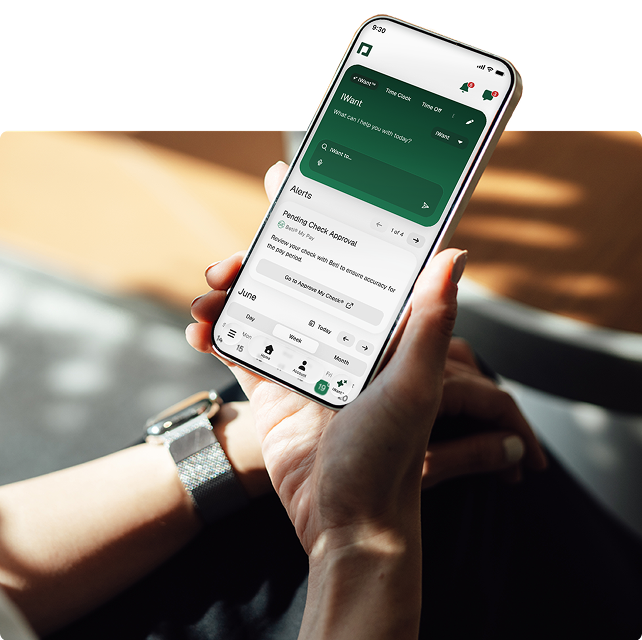
What is Paycom’s smart AI? It’s built within our proprietary single software, aiding users by eliminating decisions, steps and tasks across the HR life cycle. To further maximize efficiency and ROI for our clients in meaningful ways, our smart AI:
- writes job descriptions from a few keywords you supply
- pulls from new hires’ resumes to prepopulate their HR data, eliminating reentry
- automates HR workflows for each position based on your org’s rules
- self-starts and self-builds scheduled payrolls
- guides employees to ensure an accurate paycheck before payroll submission
- approves or denies employees’ time-off requests based on rules you set
- parses uploaded receipts to prefill employees’ expense reimbursement requests
- identifies which employees are most at risk to leave
- answers employees’ questions by searching your org’s knowledge base
- provides quick answers to clients’ questions on software setup and usage
- and much more

Holding ourselves accountable
Our stance on AI development
Transparency and explainability
We establish clear lines of accountability and governance structures to ensure our AI systems are developed and deployed responsibly, all while giving clients the game-changing automation they deserve.
Data security and privacy
Privacy and data security continue to be top priorities for clients who entrust Paycom with their personal information. All personal client data is self-hosted on our premises and duplicated across multiple facilities nationwide. AI systems are developed with privacy in mind and in strict compliance with our privacy policy and security standards. Being built as a single-database software provides additional layers of protection and, unlike others in our industry, ensures your data isn’t shared across multiple third parties.
Both on- and off-site, our comprehensive security standards and technologies are formally audited and ISO- and SOC-certified. Paycom holds five ISO certifications, including ISO/IEC 42001, the world’s first AI management system standard to address ethical, privacy and security concerns around artificial intelligence.




Retaining a human touch
While AI often can be the smartest tech in the stack, it lacks the strength of human instinct. Therefore, our oversight is vital to the secure, compliant and accountable operation of AI. That includes our service model of providing clients a single point of human contact, which AI can enhance, but never replace. Through our human-in-the-loop approach, we’re committed to identifying and mitigating bias in our systems to further promote fairness and inclusivity as we do throughout our entire organization.
Keeping an eye on AI
AI should never operate in a vacuum. Developments and enhancements are overseen, tested and reviewed prior to deployment, and monitored and reevaluated while in use by multiple departments and a data protection officer for compliance. Furthermore, AI governance regarding system and oversight effectiveness is routinely reported to our Board of Directors.
Explore the guiding principles Paycom uses to navigate AI research and development practices.

Proof behind the stance
What our smart AI decides for you
A stance on AI is only as good as what the software actually does with it. Every decision below runs on automated decisioning logic: your rules, applied consistently against one record in a single database. Each row names the tool and the decision it makes for you, so you can check the claim rather than take it on faith. All of it operates within the oversight described above.
| Tool | The decision our smart AI makes |
|---|---|
| Benefits Administration | Initial benefit-plan enrollment approval |
| Client Action Center | Direct-deposit return resolution determination |
| Beti® | Paycheck approval within a range you set |
| Expense Management | Expense approval up to an amount you set, with parsing reading uploaded receipts to prefill the request |
| IWant™ | Command-driven answer and action determination on employee data queries |
| Scheduling | Shift-swap approval or denial by your criteria |
| Time and Attendance | Timecard approval or denial, and punch change approval and denial |
| Time-Off Requests featuring GONE® | Time-off approval and denial by company policy |
Every rule above is yours to set and change, and the decisions remain visible and reversible by a human.
Automation with a model behind it
What separates AI from automation

The word “automation” describes what happens. The model describes how. Across our software, the mapping is direct:
- automated decision engines: approvals and denials
- vision language models: receipt parsing
- natural language processing: knowledge-base answers
- machine learning: flight-risk identification
- generative AI: job descriptions
The difference is what the model can see. AI bolted onto an integrated suite reads whatever data the integration passes it. AI native to a single database reads one record. That’s why a time-off decision, a timecard approval and a paycheck can be decided against the same truth source instead of three reconciled copies of it.
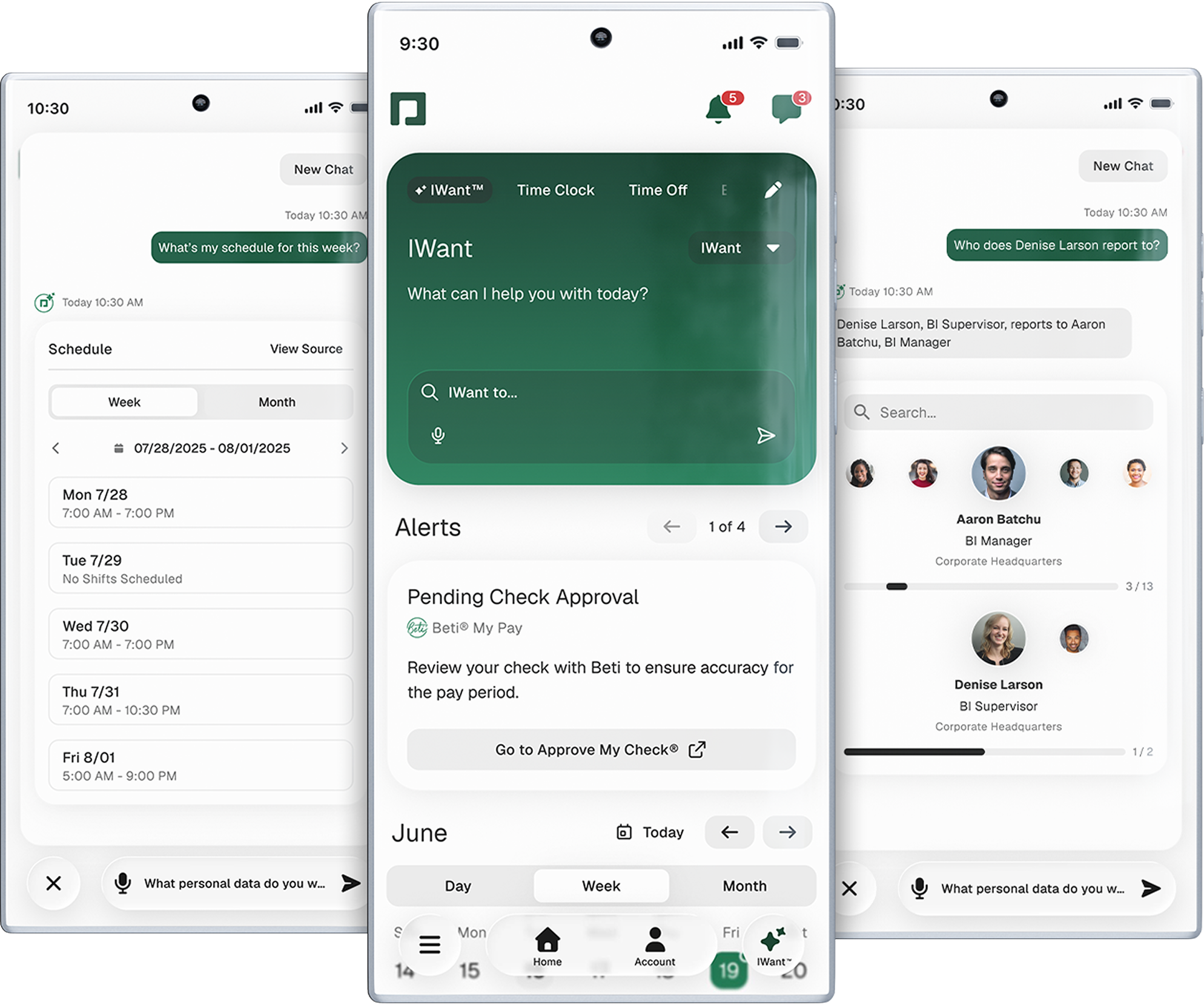

According to Forrester’s New Technology: The Projected Total Economic Impact™ Of IWant™ By Paycom study, a composite organization using IWant, our command-driven AI engine, achieved a projected three-year ROI of up to 431%, saved up to 3,600 employee hours annually and reached a projected three-year net present value of nearly $141,000.
A commissioned study conducted by Forrester Consulting on behalf of Paycom, February 2026. Results are for a composite organization based on interviewed customers.
Frequently Asked Questions
Learn more about using AI in HR software to support your vision
AI HR software is human resources software that uses artificial intelligence models (generative AI, machine learning, natural language processing, automated decision engines and vision language models) to eliminate routine decisions, steps and tasks across the employee life cycle. In practice, that means the software approves a time-off request, reads a receipt into an expense report or flags a paycheck error before payroll is submitted, under rules you set and human oversight you keep.
AI payroll software applies those same models to the pay cycle. It self-starts and self-builds scheduled payrolls, identifies errors in real time and guides employees to an accurate paycheck before submission, instead of correcting it afterward.
In Paycom’s software, AI automates initial benefit-plan enrollment, direct-deposit return resolution, paycheck approval within a range you set, expense approval up to an amount you set, shift-swap approval, timecard and punch change approval and denial, time-off approval and denial, and more.
No. The decisions our smart AI makes are routine HR and payroll transactions governed by rules you configure. Our human-in-the-loop approach keeps oversight with people, and we’re committed to identifying and mitigating bias in our systems.
It’s built into our software’s workflows and made possible by data consolidation in a single-database architecture. You define your rules; you don’t build, host or govern models.
All personal client data is self-hosted on our premises and duplicated across multiple facilities nationwide, developed in strict compliance with our privacy policy and security standards, and formally audited. Paycom holds five ISO certifications, including ISO/IEC 42001. We’re also the only HR tech company with Tier IV certification from the Uptime Institute.
It moves automation from routing work to deciding it. See how that plays out end to end in HR process automation.
Paycom uses the right model for the task. Generative AI can help create content, natural language processing can answer questions, vision language models can read documents or receipts, machine learning can identify patterns and automated decision engines can apply rules to routine workflows.
Yes. AI can search approved information, interpret a question and guide employees to an answer or next step without making them wait for a manual handoff. That keeps simple questions moving while HR teams focus on work that needs human judgment.
AI supports accuracy by using one source of data, applying rules the same way each time and flagging issues before they turn into corrections. In payroll, that can mean catching an error before submission instead of fixing it after employees are paid.
No. AI is meant to remove repetitive decisions, steps and tasks, not replace the people who set strategy, support employees and make judgment calls. Paycom’s approach keeps human oversight in the workflows where it matters.
A single database gives AI one version of employee data to read and act on. That helps reduce duplicate entries, mismatched records and extra reconciliation across disconnected systems.
Look beyond whether a vendor says it has AI. Ask what the AI does, what data it uses, how the system is governed, which decisions stay visible and how people can review or reverse outcomes.