Paycom vs. Workday: Comparing Payroll and HR Systems
This page compares Paycom and Workday across payroll, platform design, user experience (UX), daily operations, and cost and risk responsibility. The focus is on how each provider’s design choices affect accuracy, operational effort and predictability for leadership, HR, payroll and IT teams.
Paycom vs. Workday at a glance
Key differences between Paycom and Workday
Paycom and Workday pursue distinct strategies for payroll and HR platform design. Paycom centralizes payroll, HR, talent management, talent acquisition, and time and labor management in one software.
Workday offers similar functions through a product suite and partner ecosystem. These differences can affect payroll accuracy, reconciliation work, administrative workload and cost predictability, especially as organizations scale.
Platform architecture and system design
How are Paycom and Workday fundamentally different?
 |  | Why this matters | |
|---|---|---|---|
| Payroll system of record | Payroll is the foundation of the software and central to how data flows. | Payroll is a distinct module within a broader HCM and financial suite. | Payroll-first design can reduce handoffs when validating payroll inputs. |
| Database structure | Single database shared across all payroll and HR functions. | Markets a “single source of data” but often relies on extensions or partners for added needs. | One database supports one version of the truth and reduces downstream discrepancies. |
| Platform extension model | All workflows are delivered natively within the software. | Capabilities are expanded through acquisitions, extensions and marketplace partners. | Larger ecosystems can increase governance, integration and change-management overhead. |
| Data-change path | Employee-entered changes update records in real time across all tools. | Changes may flow through multiple components depending on configuration. | Shorter data paths can reduce delays, duplication and reporting inconsistencies. |
| Background checks workflow | Background checks are built into the software to streamline hiring workflows. | Background checks are available through marketplace partners or integrations. | Native workflows can reduce handoffs and data reentry in recruiting and onboarding. |
| Pay card/pay access options | Offers a native pay card option connected with payroll (Vault Visa® Payroll Card). | Uses partner-based pay card/on-demand pay options via integrations. | Native pay access options can reduce third-party coordination for payroll payments. |
| | Why this matters |
|---|---|---|
| Payroll system of record | ||
| Payroll is the foundation of the software and central to how data flows. | Payroll is a distinct module within a broader HCM and financial suite. | Payroll-first design can reduce handoffs when validating payroll inputs. |
| Database structure | ||
| Single database shared across all payroll and HR functions. | Markets a “single source of data” but often relies on extensions or partners for added needs. | One database supports one version of the truth and reduces downstream discrepancies. |
| Platform extension model | ||
| All workflows are delivered natively within the software. | Capabilities are expanded through acquisitions, extensions and marketplace partners. | Larger ecosystems can increase governance, integration and change-management overhead. |
| Data-change path | ||
| Employee-entered changes update records in real time across all tools. | Changes may flow through multiple components depending on configuration. | Shorter data paths can reduce delays, duplication and reporting inconsistencies. |
| Background checks workflow | ||
| Background checks are built into the software to streamline hiring workflows. | Background checks are available through marketplace partners or integrations. | Native workflows can reduce handoffs and data reentry in recruiting and onboarding. |
| Pay card/pay access options | ||
| Offers a native pay card option connected with payroll (Vault Visa® Payroll Card). | Uses partner-based pay card/on-demand pay options via integrations. | Native pay access options can reduce third-party coordination for payroll payments. |
The Vault Visa Payroll Card is issued by The Bancorp Bank, N.A., Member FDIC, pursuant to a license from Visa U.S.A. Inc. and can be used everywhere Visa debit cards are accepted.
Why platform architecture affects more than IT
Platform design decisions don’t stay confined to IT diagrams — they show up every payroll cycle. When payroll, HR and time data live in a single system of record, changes made by employees and managers can flow directly into payroll processing. When data is distributed across modules, extensions or partner tools, teams often spend additional time validating inputs, reconciling differences and tracking down where issues originated.
These architectural differences help explain why some organizations experience fewer postpayroll corrections and less manual cleanup as they scale. The next section focuses on how those design choices translate into day‑to‑day work for payroll teams, managers and employees.
Automation, UX and day-to-day work
Workday vs. Paycom: Which system actually reduces work?
| | Why this matters | |
|---|---|---|---|
| Payroll accuracy before payday | Beti® guides employees to review and correct pay-impacting data before submission. | Does not use the same employee-directed, presubmission prevention flow. | Preventing errors before payday can reduce off-cycle checks and cleanup. |
| Automation depth | Policies (criteria, thresholds, exceptions) can be automated with guardrails; decisions flow into payroll. | Supports auto-approval and approval workflows; configuration depth depends on tenant setup and permissions. | Automating the policy — not just routing — reduces manual intervention and exception cleanup. |
| Manager mobile workflows | Manager on-the-Go® allows managers to complete a broader set of tasks end-to-end on mobile. | Mobile supports core manager tasks; other needs may require additional modules or desktop/browser access. | More end-to-end mobile actions can reduce delays and dependency on desktop access. |
| AI interaction model | Leverages IWant™, a natural-language, command-driven AI engine built on a single database. | Uses generative AI and emphasizes governance/controls when multiple inputs influence outputs. | Record-based answers reduce ambiguity for HR/payroll questions that require precision. |
| | Why this matters |
|---|---|---|
| Payroll accuracy before payday | ||
| Beti® guides employees to review and correct pay-impacting data before submission. | Does not use the same employee-directed, presubmission prevention flow. | Preventing errors before payday can reduce off-cycle checks and cleanup. |
| Automation depth | ||
| Policies (criteria, thresholds, exceptions) can be automated with guardrails; decisions flow into payroll. | Supports auto-approval and approval workflows; configuration depth depends on tenant setup and permissions. | Automating the policy — not just routing — reduces manual intervention and exception cleanup. |
| Manager mobile workflows | ||
| Manager on-the-Go® allows managers to complete a broader set of tasks end-to-end on mobile. | Mobile supports core manager tasks; other needs may require additional modules or desktop/browser access. | More end-to-end mobile actions can reduce delays and dependency on desktop access. |
| AI interaction model | ||
| Leverages IWant™, a natural-language, command-driven AI engine built on a single database. | Uses generative AI and emphasizes governance/controls when multiple inputs influence outputs. | Record-based answers reduce ambiguity for HR/payroll questions that require precision. |
Reducing work before it turns into rework
Automation doesn’t reduce work if it requires ongoing IT support, a dedicated HRIS team or additional service plans to configure and maintain. Paycom includes guided setup tools and configurators that walk HR and payroll teams through defining policies, criteria, thresholds and exceptions directly in the software. This allows teams to configure automation themselves — without writing code, managing APIs or relying on technical specialists.
Workday supports deep configuration, but achieving similar outcomes often depends on tenant‑specific setup, partner involvement or additional tiered support. For many organizations, that means automation is technically possible but practically constrained by IT availability, consulting cycles or ongoing administrative effort.
Cost predictability, risk and accountability
What will this really cost, and who owns the outcome?
| | Why this matters | |
|---|---|---|---|
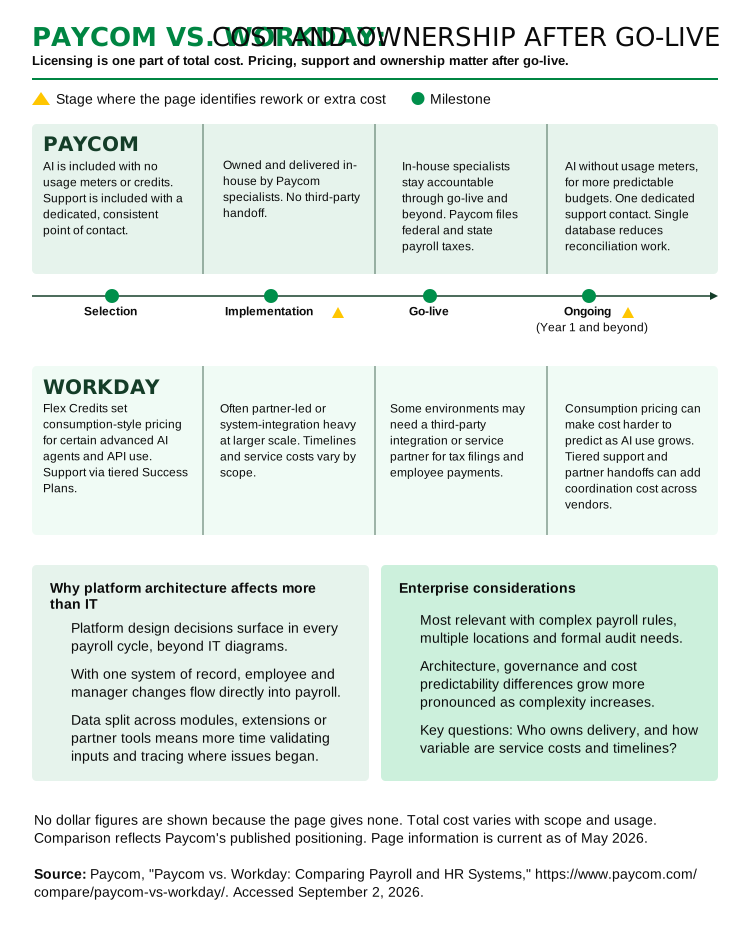
| AI pricing predictability | AI is included without usage meters/credits. | Flex Credits introduce consumption-style pricing for certain advanced AI agent/API usage. | Consumption pricing can make costs harder to predict as usage grows. |
| Support model | Support is included with a dedicated, consistent point of contact. | Offers tiered Success Plans; service partners are often involved in deployment and ongoing support. | Tiering and partner handoffs can increase coordination costs and slow issue resolution. |
| Implementation accountability/ownership | Implementation is owned and delivered in-house (not handed to a third party). | Implementations are often partner-led or system integration-heavy at a larger scale; timelines and service costs vary by scope. | Third-party reliance can add cost variability and complicate accountability. |
| Payroll tax filing responsibility | Paycom files federal and state payroll taxes on the client’s behalf within the software. | Some environments may require a third-party integration or service partner for banking transactions such as tax filings and employee payments. | Fewer vendor handoffs can reduce compliance risk tied to payment workflows. |
| Security infrastructure | Exclusively uses its own data centers and holds two Tier IV certifications. | Infrastructure is cloud-hosted, so physical controls are managed by the hosting provider. | Operational control over facilities can affect physical security oversight and accountability. |
| | Why this matters |
|---|---|---|
| AI pricing predictability | ||
| AI is included without usage meters/credits. | Flex Credits introduce consumption-style pricing for certain advanced AI agent/API usage. | Consumption pricing can make costs harder to predict as usage grows. |
| Support model | ||
| Support is included with a dedicated, consistent point of contact. | Offers tiered Success Plans; service partners are often involved in deployment and ongoing support. | Tiering and partner handoffs can increase coordination costs and slow issue resolution. |
| Implementation accountability/ownership | ||
| Implementation is owned and delivered in-house (not handed to a third party). | Implementations are often partner-led or system integration-heavy at a larger scale; timelines and service costs vary by scope. | Third-party reliance can add cost variability and complicate accountability. |
| Payroll tax filing responsibility | ||
| Paycom files federal and state payroll taxes on the client’s behalf within the software. | Some environments may require a third-party integration or service partner for banking transactions such as tax filings and employee payments. | Fewer vendor handoffs can reduce compliance risk tied to payment workflows. |
| Security infrastructure | ||
| Exclusively uses its own data centers and holds two Tier IV certifications. | Infrastructure is cloud-hosted, so physical controls are managed by the hosting provider. | Operational control over facilities can affect physical security oversight and accountability. |
Cost and accountability don’t stop at go-live
Initial licensing is only one part of the total cost of ownership. Over time, pricing models, support structures and implementation ownership play a larger role in shaping both cost predictability and accountability. Consumption‑based pricing can introduce variability as usage grows, while partner‑led delivery models may spread responsibility across multiple vendors.
For many organizations, these factors become most visible after go‑live — when AI adoption increases, support needs change or compliance complexity rises. Understanding how each platform handles these realities helps buyers avoid surprises and choose a model that aligns with their risk tolerance and operating structure.
Enterprise considerations
This comparison is most relevant for organizations managing complex payroll rules, multiple locations and formal audit requirements. Differences in platform architecture, governance and cost predictability become more pronounced as organizational complexity increases.
Frequently Asked Questions
Learn more about why businesses choose Paycom over Workday
Organizations typically compare Paycom and Workday when deciding how much system complexity they want to manage in the long term. Workday delivers a broad ecosystem that often expands through extensions and partners. Paycom delivers payroll, HR management, talent acquisition, talent management, and time and labor management within a single database, which can reduce reconciliation work, postpayroll corrections and administrative overhead as compliance requirements grow.
Paycom provides implementation through in‑house specialists who remain accountable through go‑live and beyond. Workday implementations frequently involve system integrators or service partners, particularly for larger or more complex environments. The key difference for buyers is who owns delivery and how variable service costs and timelines may be.
When critical workflows span multiple systems, teams may encounter duplicate fields, mismatched data definitions or delays in updates. A single‑database software allows employee‑entered data to flow directly into payroll and HR processes, reducing reconciliation work, improving automation reliability and supporting more consistent reporting.
Paycom provides a dedicated, consistent point of contact for implementation and ongoing support. Workday offers tiered Success Plans, and service partners are often involved in deployment and support. Fewer handoffs can make it easier to resolve issues without building a large internal HRIS or technical support team.
Workday uses a consumption‑based model (Flex Credits) for certain advanced AI features, which can introduce variable costs as usage increases. Paycom provides AI functionality without usage meters, which can make long‑term budgeting and ROI forecasting more predictable as adoption grows.
Paycom files and pays federal and state payroll taxes on the client’s behalf within the software. In some Workday environments, tax filings and employee payments may require third‑party integrations or service partners. Reducing vendor handoffs can help lower compliance risk tied to payment workflows.
Both Paycom and Workday maintain industry‑standard security certifications, but they take different architectural approaches that affect how employee data is handled. Paycom runs payroll, HR and time through native workflows on a single database, limiting the need to share sensitive data across third‑party integrations or external APIs. Workday delivers a broad enterprise platform that often extends functionality through marketplace partners and integrations, which can require additional data exchanges between systems. For security and compliance teams, fewer integrations can mean simpler access governance, fewer external dependencies to audit and clearer accountability for protecting employee data.
Paycom delivers all native workflows on a single database, which reduces the need to expose sensitive employee data to third‑party integrations or external APIs. Workday offers functionality through marketplace partners and integrations, increasing the number of systems that may access or exchange HR and payroll data. For security teams, fewer integrations can mean a smaller attack surface, simpler access governance and less ongoing effort to manage permissions, audits and compliance across vendors.
Paycom is designed for companies that want payroll and HR connected in one database to automate tasks and decisions across the entire employee life cycle. That structure can help reduce manual work, duplicate entry and postpayroll cleanup by giving employees more ownership of their own data and pay. Workday can support broad enterprise HR needs, but Paycom focuses on payroll accuracy, employee-driven workflows and accountability after implementation.
Paycom is designed to make payroll and HR easier to manage in one software. Workday can be more complex to set up and maintain, often requiring more internal resources or third-party support.
Paycom’s expense management uses automated decisioning logic to help route and approve reimbursements based on company policy, so manager approvals follow built-in guardrails instead of relying on manual review alone. Once an expense is approved, the reimbursement connects directly to payroll in the same software, helping reduce rekeying, disconnected handoffs and delays between submission, approval and pay. Compared with Workday, the difference is around faster approvals, stronger policy consistency and a more direct path from employee expense to payroll-ready reimbursement.
Ready to see Paycom in action?
We’re ready to show you the way. Request a meeting for personalized guidance based on your company’s unique needs.
Request a meeting
* indicates a required field
User Info
Contact Info
Company Info

By submitting this form, you accept our Terms of Use and Privacy Policy.